Organizing resale inventory: a storage system that pays for itself
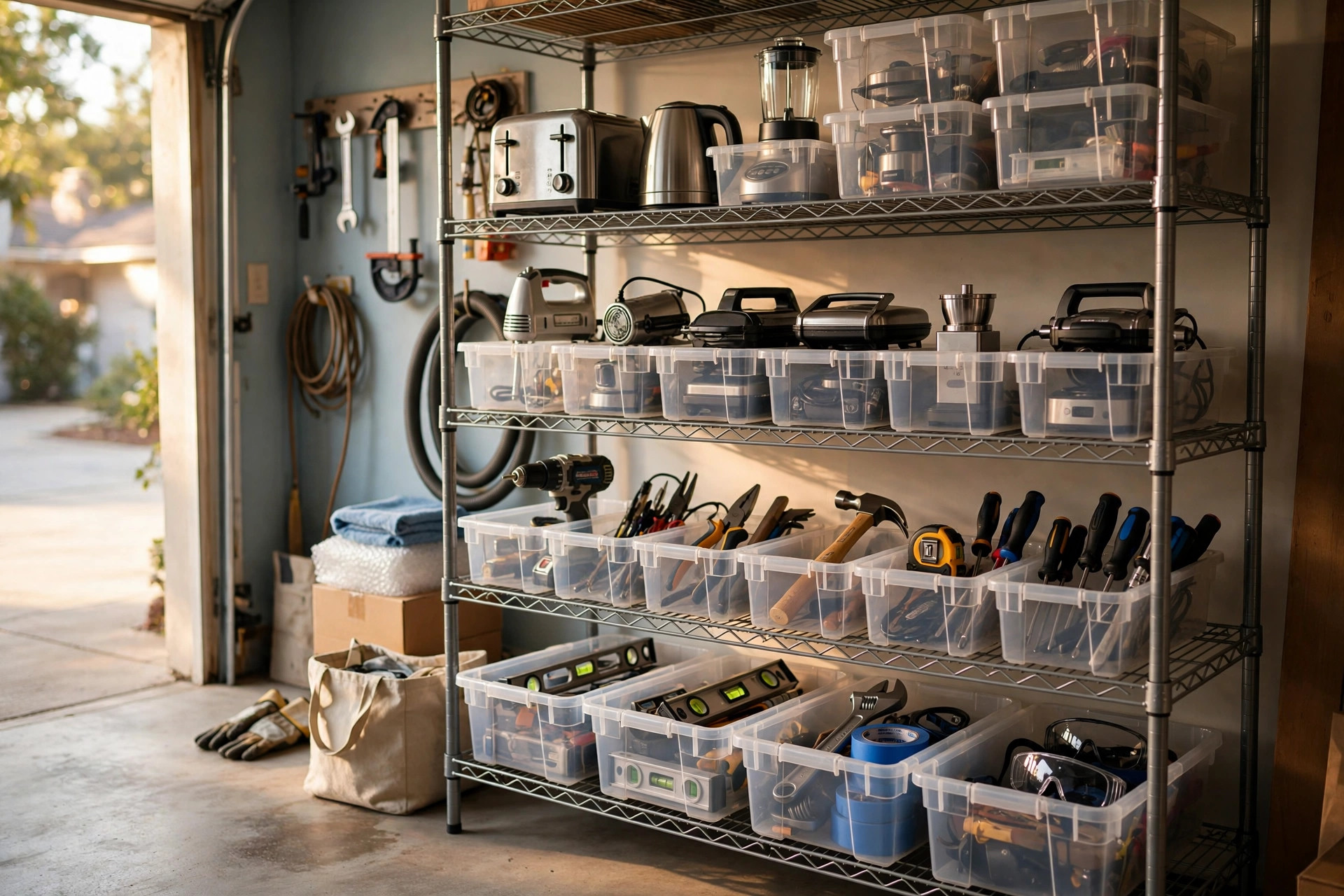
Most inventory advice for resellers is written for clothing sellers: garment bags, folded poly bags, hangers. Auction flippers have a different problem. A single pickup can bring home a power inverter, two small appliances, a box of hand tools, and one bulky item that eats half a shelf. Without a system, that mix turns into piles, and piles are expensive. Every item you own but cannot find, cannot test, or forgot you listed is money parked in the least useful place possible: your shelves.
Treat organization as a money system, not a tidiness project. The system below has three parts: a status pipeline every item moves through, a location system that lets you find anything in under a minute, and a cost-and-aging check that tells you when storage is quietly eating the margin.
Why disorganized inventory costs more than it looks
Space is finite, and bulky slow sellers pay heavy rent in it, not in dollars out of your pocket, but in the faster items you cannot stock because the shelf is full. Cash flow beats big margins in this business: $500 tied up for months chasing a $100 profit loses to a string of fast, small wins that keep money moving. A $15 to 25 profit on a cheap, small, fast-selling item you picked up on a run you were already making is good business. The same profit on a bulky item that occupies a shelf for four months is not.
Disorganization makes the problem worse in a specific way: items you cannot see are items you forget to manage. They do not get price drops, fresh photos, or promotion, they just age. The single most useful number in a flipping operation is how much you have unsold. Watching that number is what prompts the actions that move stock: promoting older items, reducing prices that have sat too long, and checking that long-listed items still have good pictures. A storage system earns its keep by making that number, and the age of everything behind it, impossible to ignore.
The four-stage pipeline: every item has a status
Clothing systems sort by category. Auction inventory should sort by status first, because an item's next action depends on where it is in the pipeline, not on what it is:
- Stage 1. Untested. Fresh from pickup. Nothing here gets photographed or listed. It waits for a test session, grouped loosely by type so similar items get tested together.
- Stage 2. Tested, unlisted. Checked, cleaned, and known-good (or honestly known-faulty). This is the photo queue. Keeping tested stock separate from untested stock means a listing session never gets interrupted by a surprise dead battery or missing cord.
- Stage 3. Listed. Live on a marketplace, stored in its numbered location, untouched until it sells. Listed stock should be the most orderly part of the room: when a sale comes in, you walk to one spot, pull one item, and pack it.
- Stage 4. Sold, awaiting pickup or shipment. A small staging area near the door. Items leave the inventory count the moment they enter this stage, so your unsold number stays honest.
Four shelves, four shelf sections, or four rows of bins, the physical layout matters less than the rule: an item's stage is visible from across the room, and nothing moves backward without a reason (a returned item goes back to Stage 1, not straight back onto the listed shelf).
Number the location, then track the item
The most proven location system is also the simplest: number each bin, and keep a manifest, a document listing the individual items inside each bin. Each item gets an ID tied to its bin, and the ID and bin number go into the manifest. When an item sells, you search the manifest instead of reading every label on every bin. A spreadsheet manifest is searchable by word, which is what makes the system fast at a few hundred items.
A common variant labels the item itself with its bin and position, an item bagged and marked "A1" lives in bin A, so the item carries its own address. Either way, record more than location. Useful manifest fields include the bin or location, a short item name, what you paid, the listing date, the listing price, and size or measurements where they matter. Two of those fields, listing date and price, are what power the aging rule below.
Two practical details from resellers who run this system at volume: leave room in the bins, because a bin stuffed to the brim makes pulling a sold item slow and scrambles everything around it; and standardize your bin size where you can. Many resellers settle on 56-quart plastic bins holding roughly 25 items each, which makes capacity planning simple arithmetic: count bins, multiply, and you know roughly how much stock you are holding.
Give the room zones, too
Status pipelines organize items; zones organize the work. A widely used layout divides a resale workspace into four zones, office, storage, photography, and shipping, with storage taking the largest share, typically 45 to 50% of the total area. A starting workspace runs about 100 to 150 square feet. Auction flippers can adapt the model directly: the photography zone doubles as the testing bench (Stage 1 to Stage 2 happens there), the storage zone holds Stages 2 and 3, and the shipping zone is Stage 4 by the door. The point of zones is flow: an item's path from pickup to sold should be a walk in one direction, never a zigzag across the room.
What storage really costs: the cost-per-item-month math
Here is the calculation almost no inventory guide runs. Take any storage cost, a self-storage unit, a rented garage bay, even the shelving you bought, and divide it by the number of items it holds. That is your cost per item per month, and every month an item sits unsold, that amount comes off its margin.
A worked example with round numbers, substitute your own rent and counts. Say a small storage unit costs $120 a month and holds 240 listed items. That is $0.50 per item per month. A fast item that sells in its first month carries fifty cents of storage cost: nothing. A slow item that sits for eight months carries $4.00, on a $20 item with a $9 margin, storage alone has eaten nearly half the profit before fees. Now run the same math on a bulky item. If one oversized piece takes the shelf space of ten small items, its honest share of that unit is $5.00 a month, not $0.50. Four months of sitting is $20 of rent charged against one item's margin. That is the arithmetic behind the rule from the pricing guide on this site: bulky items get priced to move, because their storage clock runs ten times faster.
The same math applies at home. A shelf at home is not free if it is full of eight-month-old stock while new pickups pile up on the floor, the cost shows up as chaos, damaged goods, and lots you stop buying because there is nowhere to put them. Run the division once a month. If your cost per item per month is climbing, the problem is not storage. It is aging stock.
The unsold-age rule: let the calendar make the decision
Because the manifest already holds a listing date for every item, aging is a sort away: order by listing date and the oldest stock rises to the top. Act on it with fixed triggers instead of gut feeling:
- 30 days unsold: check the listing. Are the photos good? Is the title carrying the words buyers search? Fix the listing before touching the price.
- 60 days unsold: promote it, a modest price reduction, a repost, or a share to a fresh audience. The market has seen the current offer and passed.
- 90 days unsold: decide. A deeper cut, a bundle with a faster item, a different marketplace, or a donation/write-off. What it may not do is sit for another quarter at the same price while its storage cost accrues.
For anything with a shelf life, batteries, cosmetics, dated consumables, stack new stock behind older stock so the oldest sells first (the FIFO rule: first in, first out). The triggers are the decision framework; the manifest is what makes them enforceable. Without dates in the record, "I'll drop the price soon" quietly becomes six months.
When a storage unit pays, and when it eats the margin
A unit is a tool, not a milestone. It pays when the stock inside turns fast enough that the cost per item per month stays trivial against real margins, the worked example above is the test: run your own numbers before signing anything. Inside the unit, the discipline that makes it work is basic: label everything, shelve vertically to keep stock off the floor, sort by category, keep a simple diagram of where everything lives, and put your top sellers, the roughly 20% of items that bring in 80% of sales, at the front where they are quick to pull.
And one rule before any unit, shelf, or bin purchase: purge first. Go through the slow and unprofitable stock and clear it before buying space to hold more of it. Storage bought to house dead inventory is a monthly subscription to a problem you could have sold, bundled, or donated once.
FAQ
Spreadsheet or paper manifest? Either works; a spreadsheet wins once you pass a hundred items because it can be searched by word and sorted by listing date, and the date sort is what powers the aging rule.
How many bins do I need to start? Start with what one pickup fills. At roughly 25 items per 56-quart bin, most part-time flippers find four to six bins cover the four pipeline stages until volume proves otherwise.
Should tested and untested items share a shelf? No. Mixing them means every listing session starts with re-testing. The stage separation is the system; the bins are just containers.
Is a storage unit worth it for a part-time flipper? Only if your own cost-per-item-month math says so, fast-turning stock, trivial per-item cost, margins that survive the rent. If the unit would mostly hold slow stock, the cheaper fix is the 90-day rule, applied harder.
Money note: this article is general information about organizing a resale side business, not financial or tax advice. Storage costs, fees, and resale results vary; run your own numbers before committing to any recurring cost.